The setting is ‘Clouds,’ Lady Idina Sackville’s house on Mount Kipipiri above the Rift Valley in Kenya. 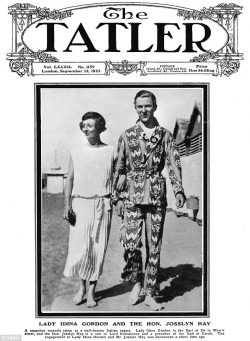
Lady Idina’s unconventional and pleasure-seeking behaviour – and indeed that of the entire ‘Happy Valley set’ (the aristocratic colonial elite who lived in Kenya between the wars) were the subject of much gossip, following the murder of her husband Joss Hay:
Other pets included two mongeese, who lived in the woodpiles on each side of the large fireplace in the sitting room and were vicious to the household cats and dogs. Ann remembered that she and Tom gave them ping-pong balls which the mongeese rolled along their stomachs before flicking them against the wall, thinking they were eggs that would smash. One night, Idina, Ann and Tom gave the mongeese some beer in a saucer, which they loved – too much – and “were soon rolling around in front of the fire – the three of us were in stitches watching them attempt to stand! It was the only time we were able to touch them.”
From: The Bolter: Idina Sackville – the Woman who Scandalized 1920s Society and became White Mischief’s Infamous Seductress. London: Virago Press, 2008 (p.265)
Note how these mongooses are here described as playing merrily with ping-pong balls, much as Gef himself amused himself for hours with a little rubber ball (later psychometrized by Nandor Fodor’s medium, Mrs Vincent). However, there is no record of Gef ever having succumbed to drink, despite visits to the Peel Castle pub.
(Idina Sackville was to become the subject of several books and films – White Mischief by James Fox, later a film; Frances Osborne’s The Bolter, a biography. Characters based on Lady Idina also appeared novels by Nancy Mitford and Evelyn Waugh).

Settlement, colonial appointments or military deployment in other countries (those of Africa, the Caribbean, or of the Indian subcontinent) – as a result of the British Empire – brought Britons into contact with mongooses, and they would sometimes bring these useful and interesting animals back with them to England. Thus, the Mitford sisters’ father David, sent to Ceylon as a tea planter and later having fought in southern Africa in the Boer War, is later recorded as having relieved the boredom of an office job (working on the publication of The Lady magazine) by bringing a mongoose with him to work and setting it to hunt rats in the building’s cellar. (A thinly-disguised account of this episode appears in Nancy Mitford’s Love in a Cold Climate).
Similarly, novelist Arthur Calder-Marshall writes in his memoir The Magic of My Youth (London: Cardinal, 1990; first published, Rupert Hart-Davis, 1951), of visiting his beloved but eccentric aunt Helen:
She opened a door into a large room. There was a noise of scuffling, and something long and thin and brown streaked past, pursued by something equally long and thin and brown. “You like mongooses, don’t you?” she asked, or rather stated, because she waited for no answer.
The only mongoose I had met previously had bit me deeply in the finger, and my opinion was that the sooner all mongooses were exported to places plagued with snakes and rats, the happier the world would be; an opinion which my experience with Auntie Helen’s pair did nothing to modify. (The Magic of My Youth, p.68-69)

The above is all to suggest that – whilst unusual – a mongoose in Great Britain in the 1930s would not have been such a completely outlandish and unheard-of sight as might first be thought; indeed, not as unusual as a mongoose would be today in the U.K. of the 21st century, outside of zoos, safari parks and insurance adverts.
 hints at Monty’s possessing one or two Gef-like characteristics, namely, a love of attention, “he is one of the most popular exhibits” at the Zoo, on account of his being a “a natural comic. He greets nearly all visitors with shrill squeals of delight, and as soon he has attracted a big enough crowd he goes into a kind of can-can dance.”
 “Where he springs from the keeper never knows […] For George has to move fast. For generations it has been the business of George’s family to kill snakes, and when you’re tackling an angry cobra you either move quicker than the snake or never move any more.”


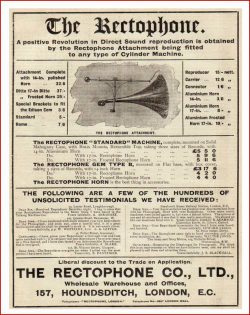 references to technology and scientific discovery (his magic phones, his rectophone, his boasts that he could split the atom or that he was “the eight dimension”) should be considered – a mongoose of modernity, but perhaps a manifestation in contemporary form of one of the Island’s folkloric creatures.
 Michael Moorcock’s Eternal Champion, we may speculate that Gef has always been with us. Certainly, he spoke of having been present in the Doarlish Cashen years before the Irvings moved in; it was only their presence, he told them, that had given him the ability to talk.
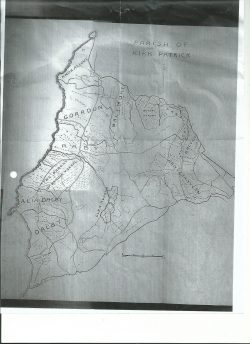 …showing the presence of Doarlish Cashen situated beside what appears to be a well-defined path or road; although there was no such road by the Irvings’ time, merely a path, in centuries past it is believed that an ancient road ran from the Port Erin in the south up to Peel in the north. This was known as the old Sound Road. If Doarlish Cashen had been constructed beside this important roadway, this would suggest the farm had been constructed several hundreds of years prior to the accepted date of the mid-nineteenth century. Certainly, its comparative size (two stories) might suggest it was home to someone important, and the medieval well on the farm indicates the site had been inhabited for several hundred years.